
Since 1912, Tri Delta’s home base, now known as Executive Office, has taken many forms. What began in an upstairs sitting room has evolved through a series of office spaces, technological advances and new ways of working. Through it all, one purpose has remained unchanged—supporting Tri Delta’s members and strengthening the sisterhood.
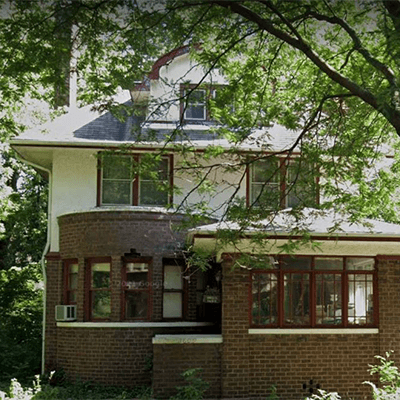
Tri Delta’s first central office was established in the home of Amy Olgen Parmelee’s parents at 1609 Sherwin Avenue in Evanston, Illinois. Amy, Northwestern, served as Fraternity President from 1906 to 1915, a period of significant expansion for the organization. As Tri Delta grew, it became clear that managing Fraternity business from a private home was no longer practical.
With the help of her sister, Louise Olgen Grotenhuis, Northwestern, the office became a more formal operation. Equipped with a typewriter, mimeograph and filing cabinets, it managed an increasing volume of correspondence and records. Tri Delta became the first National Panhellenic Conference organization to establish its own central office, an important step in the professionalization of Fraternity operations.
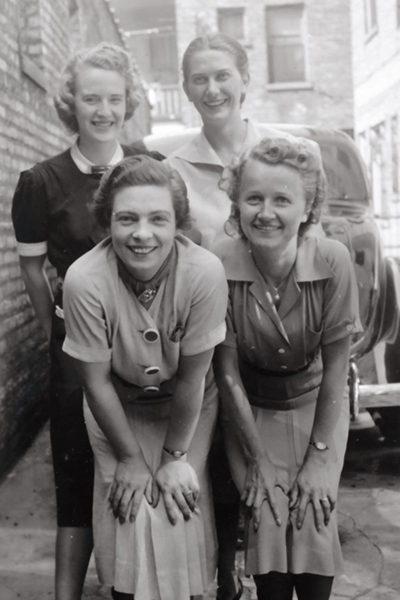
In 1917, the Council officially appointed Louise Secretary of Central Office. Her leadership proved invaluable during World War I, when several national officers were engaged in war work in the United States and overseas. Central Office provided continuity and ensured that the Fraternity’s operations continued uninterrupted during a challenging time.
As Tri Delta expanded, so did the responsibilities of Central Office. The growth of collegiate and alumnae chapters increased the need for communication, resources and member support. While volunteers played an essential role in serving chapters, Central Office became the vital connection between members and Fraternity leadership.
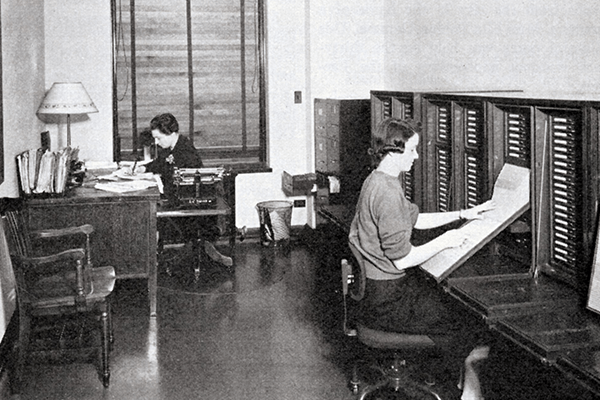
In 1938, Central Office was renamed Executive Office. By 1941, it occupied the Chicago Daily News Building, where a staff of six used increasingly sophisticated tools to support the organization’s expanding operations. Over the following decades, additional office moves reflected Tri Delta’s continued growth, including dedicated space for archives, accounting, chapter supplies and staff.
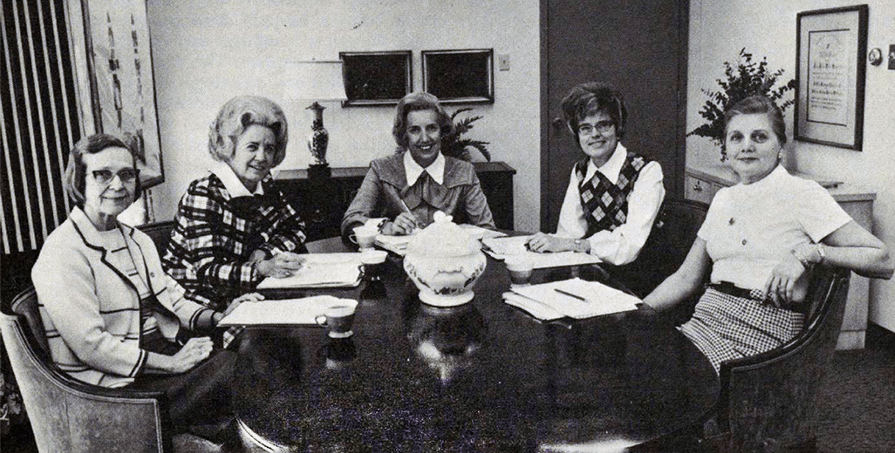
After 60 years in the Chicago area, Executive Office moved to Arlington, Texas, in 1972. Designed to support both daily operations and field staff, the new space included work areas, a conference room and even an informal living room where visiting field secretaries could stay overnight. It served not only as an administrative center but also as a gathering place for those working directly with chapters and members.
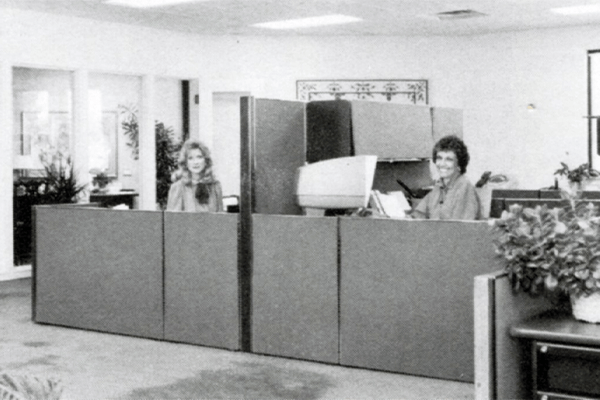
Technology continued to reshape the way Executive Office operated. Membership records transitioned from printed volumes to microfiche in the 1970s, followed by computers and word processors in the 1980s. In 1986, Tri Delta dedicated its first Fraternity-owned office building. As staff and educational programs expanded, a second building opened next door in 1998, providing additional space for training, archives and operations.
By 2016, continued growth, advancing technology and increasingly complex operations prompted another move, this time to Dallas. Tri Delta’s new Executive Office was designed to support staff collaboration, meetings, training and the Ginger Hicks Smith Museum & Archives, dedicated in 2018. Its location also created opportunities to connect with nearby collegiate and alumnae members and host chapter events.
The move to Dallas signaled a broader evolution in how Tri Delta operated. Remote work, already available to some employees, became a more established part of the organization. When the COVID-19 pandemic arrived in 2020, Executive Office quickly transitioned to fully remote operations while continuing to support members across the country. That summer, Tri Delta held its first virtual Convention, demonstrating that even long-standing traditions could adapt to changing circumstances.
The experience helped redefine the future of Executive Office. Remote operations expanded opportunities to recruit talented staff beyond the Dallas-Fort Worth area and strengthened connections with members and communities nationwide.
More than a century after Amy Parmelee’s family home first served as Tri Delta’s headquarters, Executive Office continues to evolve. The locations, tools and workplace models may change, but the mission remains the same—supporting members, advancing the Fraternity and strengthening the bonds of sisterhood.
Today, Tri Delta’s home base is not defined by a single building or address. It lives in the people who serve, lead and support our members every day, carrying forward a tradition of connection, service and sisterhood that has endured for more than 100 years.
Executive Office locations
1912-1916 Room in the home of Amy Parmelee’s parents at 1609 Sherwin Avenue, Evanston, Illinois.
1916-1917 Room likely on North Clark Street in Evanston, Illinois.
1917-1922 Another location in Rogers Park, retaining the postal address at 1609 Sherwin Avenue.
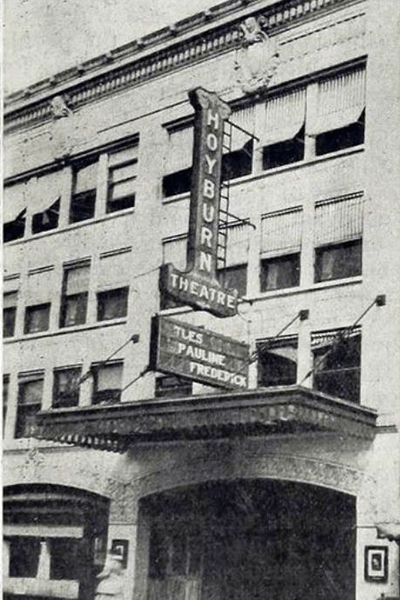
1922-1923 Hoyburn Building, 615 Davis Street, Evanston, Illinois.
1923-1941 1718 Sherman Avenue, Evanston, Illinois. Second floor of the Studio Building.
1941-1956 2108 Chicago Daily News Building on West Madison Avenue, Chicago, Illinois.
1957-1961 1709 London Guarantee Building, 360 North Michigan Avenue, Chicago, Illinois.
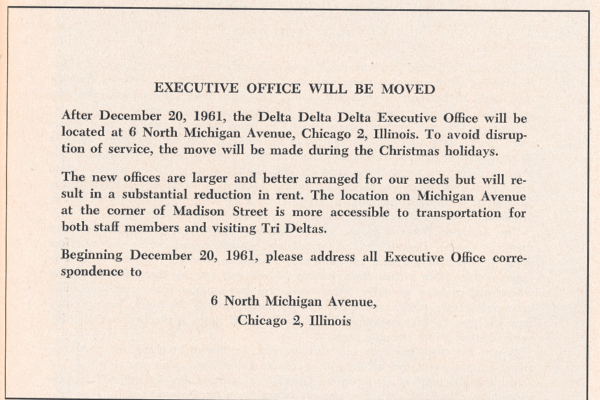
1962-1971 Suite 600, 6 North Michigan Avenue, Chicago, Illinois.
1972-1985 Suite 103, Parkway Plaza, 81 Avenue H East, Arlington, Texas.
1986-1998 2313 Brookhollow Plaza Drive, Arlington, Texas.
1998-2016 2331 Brookhollow Plaza Drive, Arlington, Texas.
2016-2026 14951 Dallas Parkway, Suite 500, Dallas, Texas.